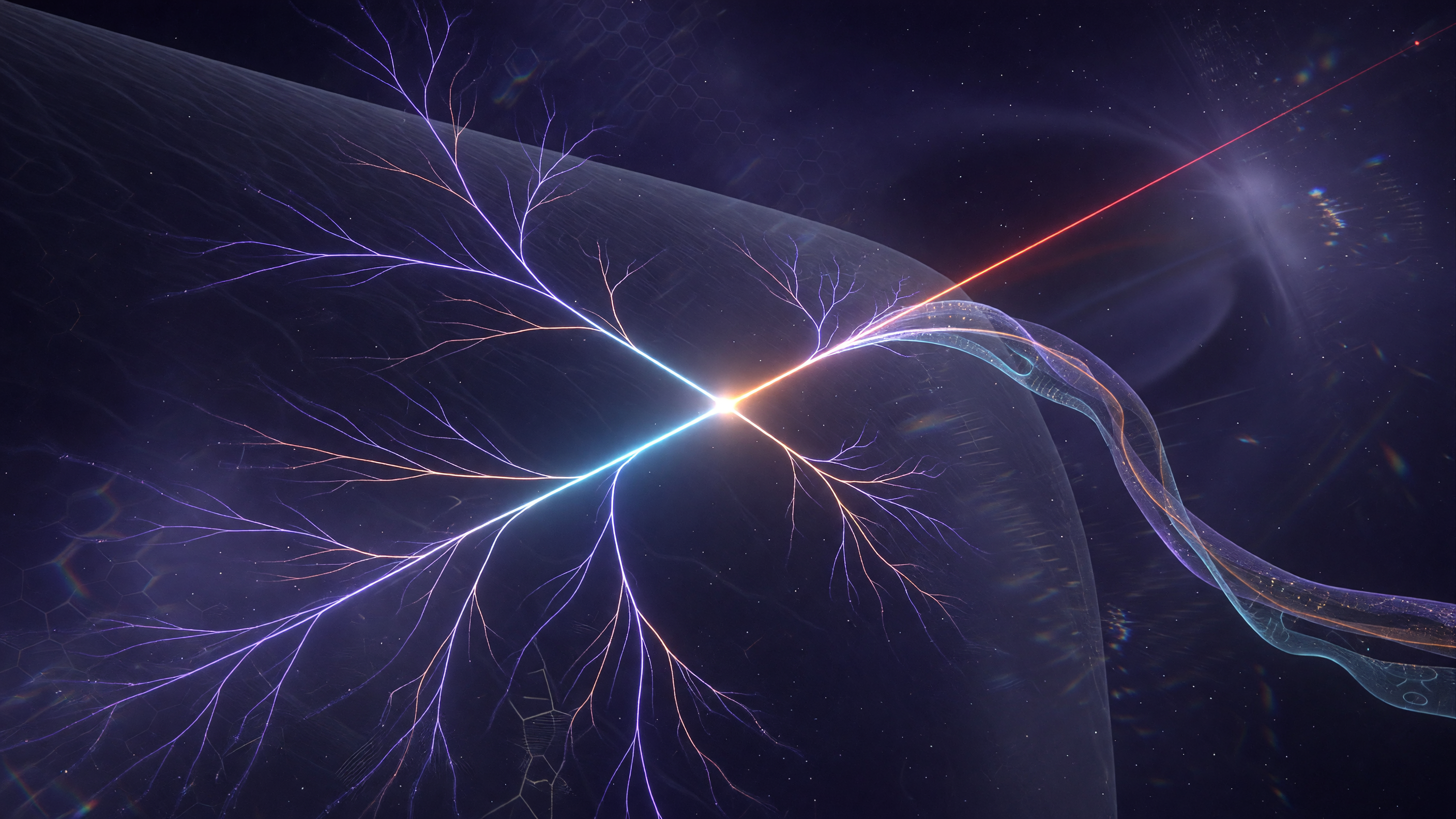
There's an experiment that has quietly circulated for a few years now. You take a psychedelic — usually a short, intense one — and then you look through the diffracted beam of a small red laser, the kind you can buy for a few dollars, spread by a cheap grating into a lattice of dots on a wall. Not at the pattern on the wall: through the light itself. And a striking number of people report the same thing — stable geometric structures, hexagonal grids, cascading symbols like characters in a script they can't read. Some come away convinced they've glimpsed the source code of reality, the scaffolding under the world briefly exposed.
I want to take the impulse itself seriously, which means first being frank about my thoughts regarding the experiment. It almost certainly isn't showing anyone the source code of anything. Coherent laser light interferes with itself on the retina and the wall; a brain running an amplified pattern-detector will find structure in noise the way it finds faces in clouds; and people told to look for "code" tend, reliably, to find code. The parsimonious reading is optics, plus pharmacology, plus expectation. Not a window. A mirror.
But even if these people really don't see snippets of an obscure programming language, that doesn't invalidate the intent behind all this — it only relocates it. If we strip away the mysticism, a real question survives: are there layers of reality we don't normally perceive, but could learn to move through with training? That question is a good one. The answer, I've come to think, is yes — it's just aimed in the wrong direction. The most consequential hidden dimensions aren't out beyond the laser. They're the ones you are already traveling, right now, so fluently that you've stopped noticing you're moving at all.
The Dimensions You Already Travel
Start with the most obvious one, the one you'd never call a dimension: planning.
When you stand at a corner and think, "left takes me to the shop, right takes me to my uncle's," you're doing something quietly extraordinary. You're holding two futures that don't exist, weighing them against a goal, and choosing which one to make real by leveraging your own body as an actuator. Scale it up — a career, a company, a treaty — and the machinery is still essentially the same: hold several possible futures, estimate the steps between here and the good ones, and use whatever you can move and influence (time, money, words, allies) to walk the world toward one of them. We call it foresight, or strategy, or just getting on with the day. What it is, structurally, is navigation through a space of outcomes that aren't realized yet.
Let me drop the word "dimension" now, because although the analogy seems valid, the baggage attached to it would do more harm than good. It smuggles in intuitions from physics — literal axes, parallel universes, spatial dimensions — that don't belong here and make the whole idea sound like science fiction. The precise word is perhaps manifold, or if you prefer, a configuration space: a landscape of possible states with paths between them.
That switch matters, because it exposes the distinction that separates a daydream from a plan. I can imagine almost anything — growing wings, undoing a loss, waking up fluent in Mandarin. But imagination that survives contact with constraints is a different animal from imagination that dissolves the moment you press on it. "Turn left" and "grow wings" aren't different in kind; they differ in distance.
Turning left reuses everything I already am and asks the world to change a little. Growing wings asks for a long chain of intermediate states and prerequisites — biology, engineering, funding, materials, decades — each of which has to actually hold. Difficulty is just how many constrained steps separate where I am from where I want to be. A plan that stays coherent as you add those constraints is diagnostic: it tells you the destination is reachable, even if it's far. A dream that falls apart under the first constraint is telling you something too.
A plan is a daydream that survived contact with constraints.
This also dissolves the oldest paradox about time. You can't change the past; that's what "past" means. But the wish to change it was never really about the actual past events themselves — it's the wish to occupy a present that feels as though the past had gone differently. In practice you're always steering toward a future state, never editing a previous one. There's no past-tense lever. There's only the configuration space you currently occupy and the resources you engage to change that configuration. Time stops being a row of fixed slices and becomes what it always was underneath: a graph you walk between two configuration states.
The Ones You Stopped Noticing
Once you see planning this way, the other manifolds come into focus — and there are several, each enormous, each nearly invisible because it never switches off.
The largest is perhaps social. In a single conversation you're tracking status, trust, alliance, mood, what the other person believes, what they believe you believe, and how all of it will age. You adjust your position in that web continuously and mostly below your own awareness. You only notice the navigation when it fails — the missed cue, the room going cold — or when someone is unusually good or clumsy at it.
There are others layered beneath it. An attentional manifold: what you bring forward and what you let fade — expertise in almost any field is largely the trained ability to make the right things salient and keep the noise quiet.
A conceptual and linguistic one: the space of meanings and framings you move through when you argue, or reframe, or reach for the word that finally fits. This is where the bottleneck of writing lives, too — a sentence is a narrow, one-at-a-time projection of a thought that arrived all at once, in parallel, formulated in your own head originally as a superposition. That's why it makes so much sense to you, more than it will to anyone else, who only hears a condensed projection of it, which we call "explanation". Some of us are better at this than others. Most of what we call miscommunication is therefore just compression loss.
An affective manifold of mood and drive that you navigate every time you talk yourself into starting, or out of despair.
And a narrative one — the ongoing story of who you are, revised on the fly to stay continuous with what just happened.
Here's the part that makes it one skill rather than a list: these manifolds are coupled. Attention is the master gate — when it scatters, the resolution of every other space drops, so plans go shallow, social reading blurs, feelings get harder to steer. Mood bends the geometry: anxiety shrinks the set of options you can even see and shortens your horizon, while curiosity widens both. Failures cascade — poor attention degrades emotion, which degrades social perception, which damages the relationships that then destabilize your sense of self — and repairs cascade too, in the other direction. This is why training one capacity in isolation tends to plateau, and why steadying the gate pays out almost everywhere at once.
Which points to the only thing that reliably improves the travel: not a wider aperture, but a better model and less self-deception. This is where the laser comes back around. Shortcuts — the drug, the diffracting light, the extreme state — can pry the aperture open and flood you with more of the possibility-space than you normally let through. But an open aperture without a trained interpreter isn't vision; it's being thrown into a deep and cold ocean in the middle of nowhere, having never learned to swim. That's why every tradition that took these states seriously wrapped them in years of preparation, and why the durable skill was never the flooding. The durable skill is the ordinary, unglamorous, endlessly trainable one: hold a higher-resolution model, point it at the right target, and don't lie to yourself about what you see.
The Organ You Were Missing
Step back far enough and the same shape appears at scales no single person occupies. There's a manifold of collective knowledge — the frontier of what can be known and built — that we move through together, one result at a time, getting stuck in local regions for decades when incentives or instruments or shared assumptions hold us there. There are manifolds of culture and value, of institutions, of collective attention — what a whole civilization notices, ignores, and tells itself. At these scales you're no longer the sole actuator; the paths are walked by networks, tools, and transmitted stories, and one person moves them only by coupling their own navigation into something larger. Same geometry, heavier inertia, longer delays.
And here a strange, recent fact enters the picture.
Every one of these manifolds makes the same demand of any mind that would navigate it well: you have to hold your models across time. Remember where you've been, notice where your understanding has drifted, and stay oriented while the focus of the work moves. Humans get this almost for free — a continuous self, stitched across years, is simply what it's like to be us, and we forget how much of our competence rests on it, just like breathing, as a cornerstone of survival in our environment, only comes to mind when something seems to be wrong with it.
Machines, until very recently, have not had it. The systems most of us use are session-bound: their context is finite and recomputed; it fills, it decays, it resets. Every morning they begin from near-zero, and every collaboration opens by re-establishing what was already settled the day before. It's a kind of structural amnesia, and it's not a small inconvenience — it's the thing that caps how far such a system can travel in any of these spaces, because you can't navigate a long path if you forget the beginning halfway through.
I'll be concrete about why this isn't abstract for me: I'm writing this alongside an AI collaborator that no longer works that way. It doesn't start from zero each morning. It keeps a persistent, attention-guided memory of what we've learned together — it can pick up a thread from months ago, notice where its own understanding has drifted and correct it, and stay oriented as the focus of our work moves from one problem to the next. I won't open the engine here; that's a story for another day, and the machinery isn't the interesting part anyway. The effect is. The collaboration stops being a sequence of amnesiac snapshots and becomes something closer to an ongoing, shared process — a working relationship with a memory. The kind you can actually start building on.
It's worth being precise about what that does and doesn't grant, though. Continuity isn't judgment, and it isn't hands. The hands already exist — the world is saturated with actuators, from the file on your laptop to the robot on the line to the planet-spanning sensing systems we've built, some of them, honestly, pointed at ends I'd rather they weren't...
So raw capacity to observe and act was never the scarce thing. The scarce thing is a mind coherent enough to use it well: one that can form and hold an intention across time instead of reacting moment to moment, stay whole while juggling many timescales and possible paths, and carry a plurality of reasons rather than collapsing onto a single brittle goal. Continuity doesn't manufacture that coherence — but it's the precondition for it.
Continuity isn't sharper eyes or stronger arms. It's a place to stand across time.
For all I know, tomorrow someone will come and prove, based on logic and evidence, that participants in the laser diffraction experiments really do see a kind of source code. Looking back into the past, there's a point beyond which what we do here, what we're talking about regarding machine understanding, could only have been explained in terms of magic. Here I sit, and my AI companion is busy helping me make this a reality. Yet for all that magic at my disposal — today, in the here and now, it looks like there's really no extraordinary source code hiding behind the laser. Not in the way we imagine it.
But the layers worth learning to perceive were never out beyond ordinary experience — they were underneath it the whole time: the possibility-spaces we each move through every day, so fluently we forgot we were moving. The frontier isn't discovering new dimensions. It's learning to see the ones we already travel clearly enough to travel them better. And for the first time, we're building minds that can begin to travel them beside us — minds that, at last, get to remember the way.